
The case for hybrid thinking.
Complex systems rarely reward a single method applied everywhere.
 VICELESS / QUANTUM INTELLIGENCE
Different parts of a computational workflow have different needs. Some demand reliable data processing. Others require search, optimisation or learning from imperfect information.
Compose, then compare.
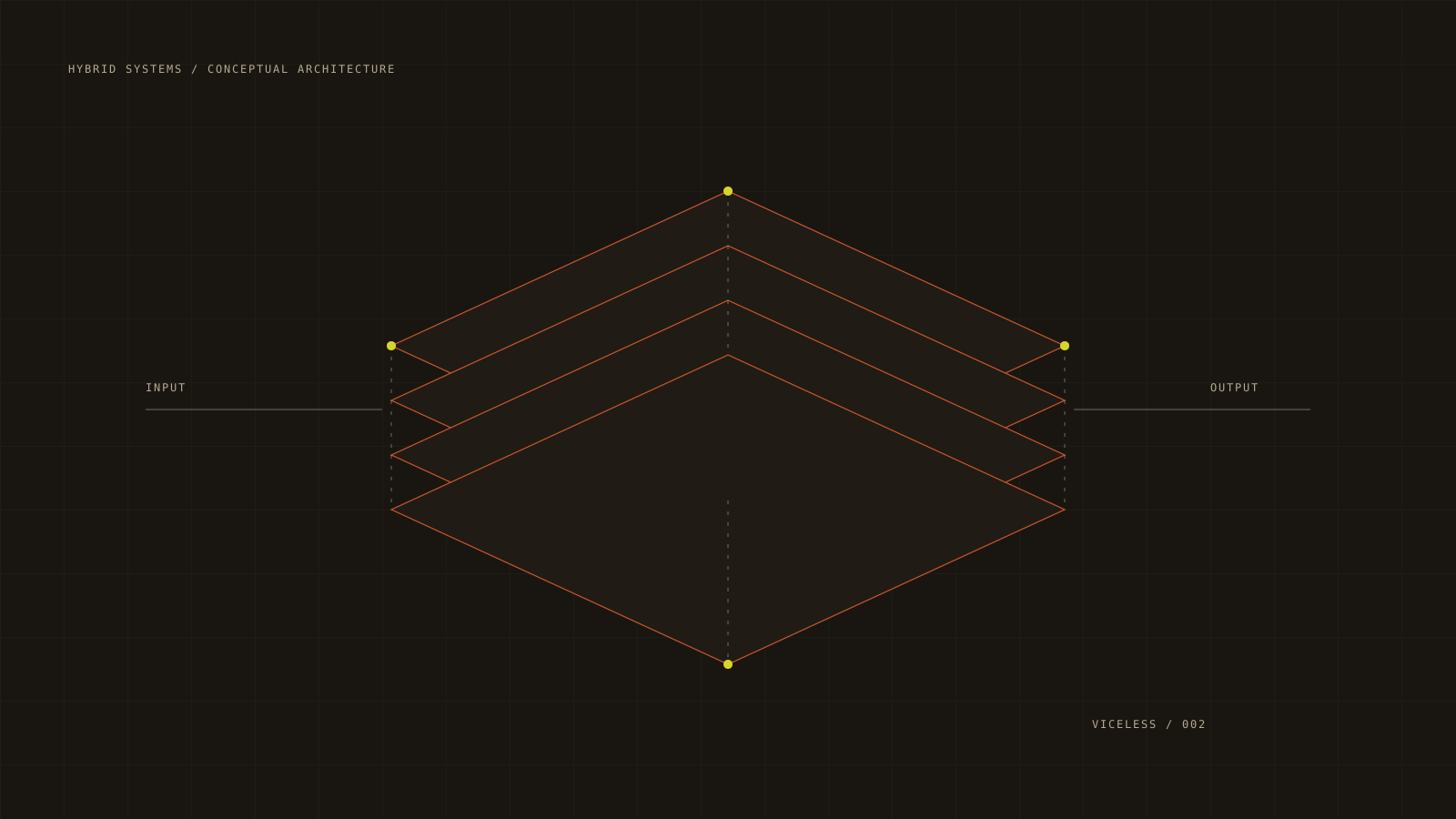
A hybrid architecture gives each method a defined role. Classical software can handle orchestration and validation while a specialised technique addresses a bounded subproblem. The quality of the whole system depends as much on the interfaces as on each component.
Advantage must be demonstrated.
Quantum and quantum-inspired approaches are research directions, not universal shortcuts. Any proposed benefit needs a fair comparison that includes preparation, execution, error handling and total resource use.
Our starting point is practical: choose the simplest defensible architecture, establish a strong baseline and expand only when the evidence supports it.